

We built Kloup
while raising our own.
Not as a thesis. As a survival tool — the thing we wished existed at 9pm on a Tuesday, three weeks deep into a round.
Three companies. Three raises.
Same tracker, rebuilt from scratch.
Same deck, rewritten for ten audiences.
Same data room, scrubbed for every new investor.
Same monthly update — different month, identical shape.
We knew it cold, and we still hated every part of it.
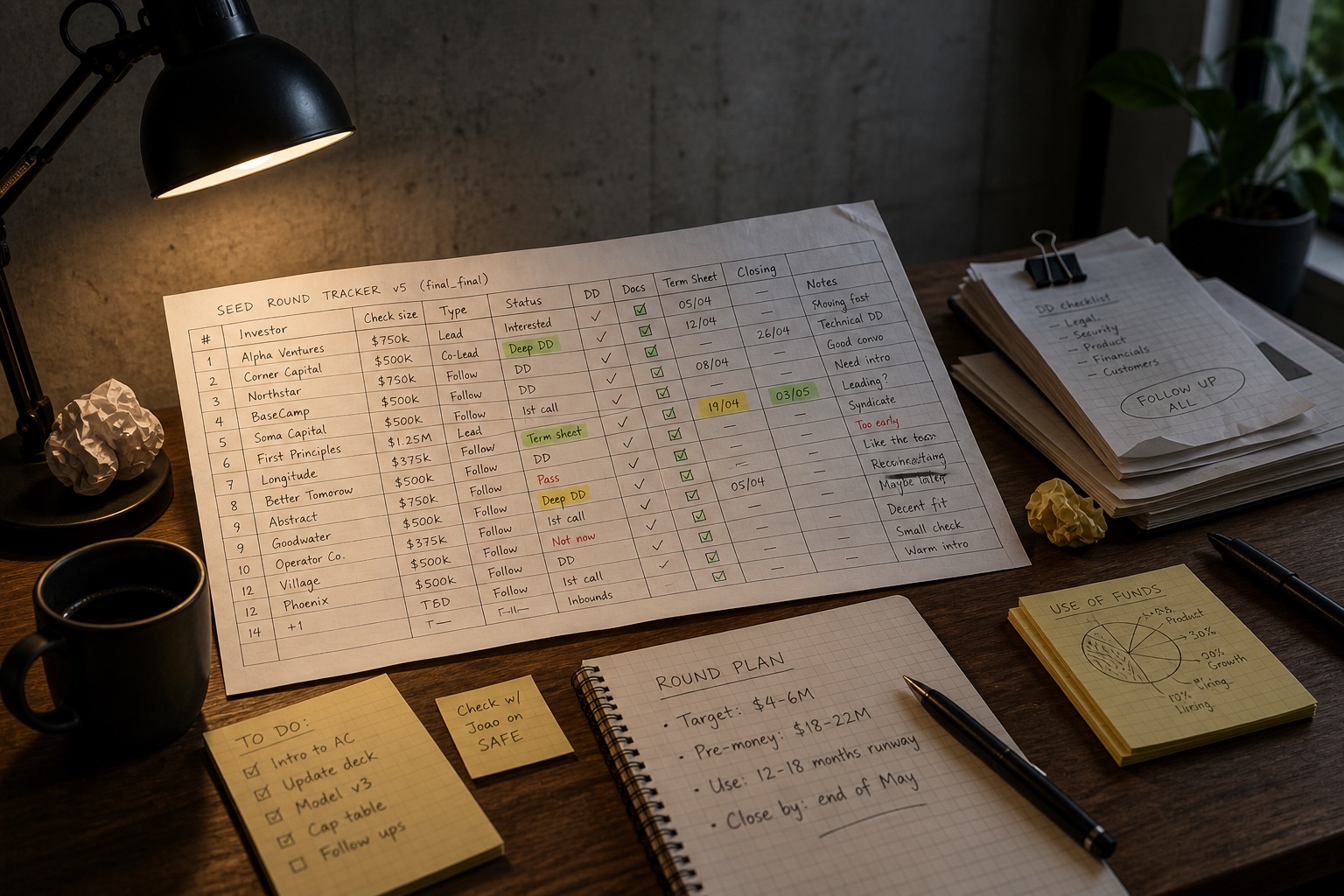
A spreadsheet, a folder, a graveyard of tabs.
Tracker in Sheets. Deck in Notion. Data room in Drive. A calendar shared with too many people. Gmail labels we'd never get back to. We rebuilt the same scaffolding three times — and it broke at exactly the same place each time.
Investors aren't asking because they're nosy.
They're asking because their investors are asking them.
LPs lean on funds. Funds lean on portfolio. Information moves in one direction so the money can move in the other. When the signal stops, the money does too.
A shared system is the only thing that serves both.
The founder isn't building a report; the investor isn't running an interrogation. When the work and the signal live in one place, the update writes itself and the answer is already there — for whoever needs it next.
Every founder has lost a round to bad follow-up.
Not because the product was wrong. Because the system around it never caught up to the work.
Writing an update feels like an hour you'll never get back.
Especially when the deal didn't close.
Especially when you missed the number.
Especially when there's still code to ship and a customer to win back.
We're founders. We get it.
What if your raise
ran like a product?
Every feature started as a workaround.
We wrote Kloup while running our own pre-seed, then a bridge round. Every screen began as a frustrated workaround in a spreadsheet — then a one-off script — then a tab. When enough tabs lived in one place, that place was Kloup.

Meet Kloup.
The tool we needed for our own raise — now the one surface founders run on and investors trust.